
CHEMTOXBIOLAB
SERVICES
Chemtoxbiolab was established by academicians from Yıldız Technical University and an experienced team that has been operating in the private sector for many years. As a result of the team spirit and synergy created by this team, it has become the first accredited laboratory in Turkey for ISO 10993-18 Chemical Characterisation and one of the few accredited laboratories in Europe. Chemtoxbiolab has started to work for Good Laboratory Practices (GLP) in the field of both chemical and physical characterisation tests of medical devices and has set the target of completing the process in 2024.
01.
Chemical Characterisation
Chemical Characterisation Test is an important and necessary test performed within the scope of ISO 10993-18 standard, especially for material selection, which is one of the most important criteria in the design of the Medical Device.
According to the result of this test, not only the material composition, but especially the determination of extractive and leachable substances should be determined in order to perform a risk-based assessment analysis in determining the biological compatibility of the product.
This analysis method, which can also be used to determine the equivalence of a medical device, is also used to determine the equivalence of a proposed material to another product. It is a rapid test method for screening potential new materials for suitability for a medical device, especially for a final device / prototype or a proposed clinical application.
In order to simulate the worst case scenario in the application of this test method, working protocols should be established in different extraction environments (polar – semipolar – non-polar) in ISO 10993-18 standard and tests should be carried out in accordance with the specified methods.
The main starting point of the study is to calculate the analytical evaluation threshold, to determine the correct level of AET and to categorise it into three main groups according to their chemical properties
• Non-Volatile Organic Compounds (NVOC)
• Semi-Volatile Organic Compounds (SVOC)
• Volatile Organic Compounds (VOC)
Data are generated by analytical methods using the devices specified in the standard. These data constitute input for toxicological evaluation.

02.
Toxicological Risk Assessment
Toksikolojik Risk Değerlendirmesi ISO 10993-17 Toxicological Risk Assessment of Medical Device Constituents
Toxicological risk assessment is basically; a method in which it is evaluated whether the materials in question in the production of the medical device subject to the test pose any toxicological risk according to the result of the analysis of the extractable and leachable substance amounts performed according to the ISO 10993-18 standard. In particular, the fact that the expert performing this risk assessment is a toxicologist certified by the European Society of Toxicology is the most important criterion that manufacturers should look for that the assessment to be made is competent and sufficient.

03.
Physical and Chemical Performance Tests
Catheters
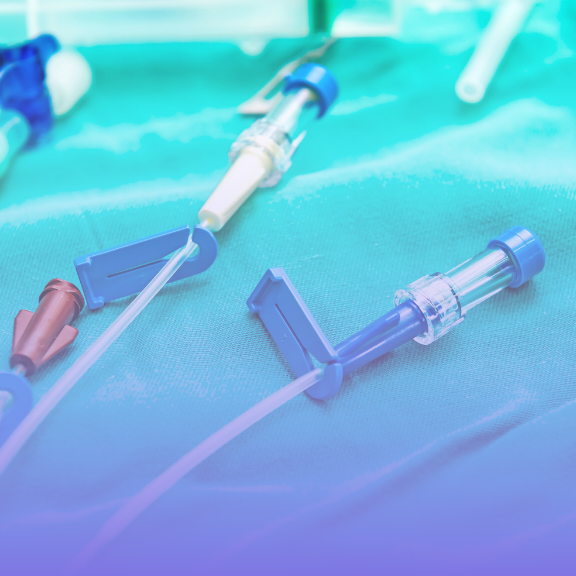
The aim of the study is to test all catheters (such as aspiration catheter, chest catheter, rectal catheter, IV cannula catheter, Tiemann catheter, Nelaton catheter) within the scope of ISO 8836, ISO 10555-1, ISO 20696 and ISO 20697 standards.
Syringes
The aim of the study is to test the accuracy of the chemical and physical requirements of ‘disposable sterile hypodermic syringes’ according to ISO 7886-2 standard. Among the physical requirements, graded capacity tolerance, graduated scale, syringe design, piston/piston assembly, nozzle, performance and packaging tests are performed according to ISO 7886-2 standard. Chemical tests required include acidity or alkalinity limits, lubricant and extractable metal limits tests.
Connector Tests
The aim of the study is to test the accuracy and adequacy of the physical requirements of small diameter connectors used in the healthcare field according to the ISO 80369-20 standard.
The physical requirements include tests such as leakage by pressure drop, leakage of positive pressure liquid by falling drop, air leakage at sub-atmospheric pressure, stress cracking, resistance to separation from axial load, disconnection by disassembly, etc.
Needle Tests for Syringes
The aim of the study is to test the accuracy of the chemical and physical requirements of “disposable sterile hypodermic needles” according to ISO 7864 standard.
Physical requirements include size determination, colour coding, needle hub, needle cap, needle tube, needle tip, bond between hub and needle tube, lumen opening and fragmentation tests.
Among the required chemical tests, acidity or alkalinity limits and limits for extractable metal tests are analysed.
Infission Set
The aim of the study is to test the accuracy of the chemical and physical requirements of disposable fluid lines with pressurised infusion equipment according to ISO 8536-9 and ISO 8536-4 standards.
Physical requirements include transparency, tensile strength, leakage, protective caps control. In addition, the size control of the needle in the infusion set, needle tip inspection, fragmentation test and penetration test are performed according to ISO 8536-9.
The required chemical tests include: Reducing (oxidisable) substance, Metal ions, Titration acidity or alkalinity, Evaporation residue, UV absorption of the extract solution.
Spinal and Trauma Implants
ASTM F 2267 (Intervertebral Body Fusion Device Under Static Axial Compression)
ASTM F2077 (Test Methods For Intervertebral Body Fusion Devices),
ASTM F 382 Standard Specification and Test Method for Metallic Bone Plates
ASTM F 384 Standard Specifications and Test Methods for Metallic Angled Orthopedic Fracture Fixation Devices
ASTM F 1717 Standard Test Methods for Spinal Implant Constructs in a Vertebrectomy Model
ASTM F 1798 Standard Test Method for Evaluating the Static and Fatigue Properties of Interconnection Mechanisms and Subassemblies Used in Spinal Arthrodesis Implants
ASTM F 1541 Standard Specification and Test Methods for External Skeletal Fixation Devices
ASTM F 1264 Standard Specification and Test Methods for Intramedullary Fixation Devices
ASTM F 543 Standard Specification and Test Methods for Metallic Medical Bone Screws
ASTM F 1264 Standard Specification and Test Methods for Intramedullary Fixation Devices
according to the standards.